


This is a free printable habit tracker you can download, print, and start using today. It comes as a six-page PDF with a monthly habit tracker, a weekly habit tracker, habit design cards, and a monthly review page. There is also a completed example, filled in the way we recommend, so you can see what good use looks like before you commit ink to your own.
Download the free habit tracker (PDF) | See the filled-in example (PDF)
No email required. Below we walk through each page, the rules that decide whether a tracker helps or quietly becomes guilt on paper, and how to choose between the monthly and weekly layouts.
What is in the free habit tracker printable
Most habit tracker templates are a single grid. A grid is useful, but it is the last step, not the first. If you have not decided when a habit happens, what counts as done, and what you do on a bad day, the grid just records the fact that you did not do it. So this printable has four parts, each with one job.
- Habit design cards (page 3). Three cards that turn a vague intention into something you can check off: the habit, the cue it follows, a tiny version, a clear definition of done, and a plan for the day it goes wrong.
- Monthly habit tracker (page 4). A 31-day grid with room for nine habits. Best for spotting streaks and patterns across a full month.
- Weekly habit tracker (page 5). Seven columns, ten rows, and a "done means" column next to each habit. Best when you are building a routine from scratch.
- Monthly review (page 6). A short table where every habit gets a decision: keep, adjust, or drop.
Print the whole thing once, then reprint pages 4 and 5 as you need them. The design cards and review page are meant to be filled in once a month.
Monthly vs weekly habit tracker: which one to use
Both layouts track the same thing. The difference is how much you can see at once, and that changes what you notice.
| Layout | Best for | What it shows you | Watch out for |
|---|---|---|---|
| Monthly tracker | Habits you already do most days and want to keep steady | Streaks, and which days of the week keep breaking | Early misses feel bigger because the whole month is staring back at you |
| Weekly tracker | New routines, or restarting after a rough patch | Each week as a fresh start, plus what "done" means for every habit | Harder to see long-term trends unless you keep the old sheets |
| Both together | People who like a daily check-in and a monthly overview | Detail and the big picture | Double entry. Only do this if you enjoy it. |
If you are unsure, start with the weekly page for the first two weeks, then move to the monthly grid once the habits feel settled. That order matches how most routines actually form: a shaky start, then a stretch where the main risk is drifting off.
Choose your tracker by the problem you have
The right habit tracker template depends less on taste and more on why your habits have not stuck so far.
- "I start strong and quit by week two." You are probably tracking too much. Use the weekly page with three habits only, and fill in the tiny version on the design card. The goal for the first fortnight is to keep the chain alive, not to impress anyone.
- "I forget to do it." This is a cue problem, not a motivation problem. Spend your time on the "After I..." line of the design card. Anchor the habit to something you already do every day. Our guide to habit stacking goes deeper on this.
- "I do it, but I am never sure if it counts." Fill in the "done means" column on the weekly page. If you have to argue with yourself about a box, the definition is too loose.
- "I have kept it up but it still feels like effort." Use the monthly grid and be patient. Automaticity takes longer than the internet tends to promise, which we cover below.
- "I would rather use my phone." That is fine. We compared options in the best habit tracking apps. Paper still has one advantage: it sits on the fridge and reminds you without a notification.
Page 1: habit design cards
Fill these in before you track anything. Each card has five lines, and each line solves a specific failure point.
The habit
Write it as an action, not an outcome. "Walk 20 minutes" rather than "get fit." "Read 10 pages" rather than "read more." If it cannot be checked off in a single day, it is a goal, not a habit, and belongs on a goal setting worksheet instead.
After I...
This is the cue. Pick something you already do at the same time every day without thinking: pouring coffee, getting into bed, turning on the dishwasher. A habit with no cue relies on remembering, and remembering is exactly what fails on a busy day.
Tiny version
The smallest possible version that still counts. Shoes on and walk to the corner. Read one page. The tiny version is not your target. It is what you do on days when the full version is not going to happen, so the streak survives and you do not have to restart from zero.
Done means
One sentence that ends every argument. "Out the door, any pace." "Book, not phone." Write it before day one, not after a day where you are tempted to count a half effort.
If this goes wrong
Plan for the most likely obstacle in advance. Rain, travel, a late night. Psychologists call this an if-then plan, or implementation intention, and it is one of the better-studied tools for closing the gap between intending to do something and actually doing it. You do not need to plan for everything, just the one thing you already know will happen.
Page 2: the monthly habit tracker
The monthly page is a 31-day grid with a row for each habit. Write the month and your focus at the top, list your habits down the left, and mark each day.
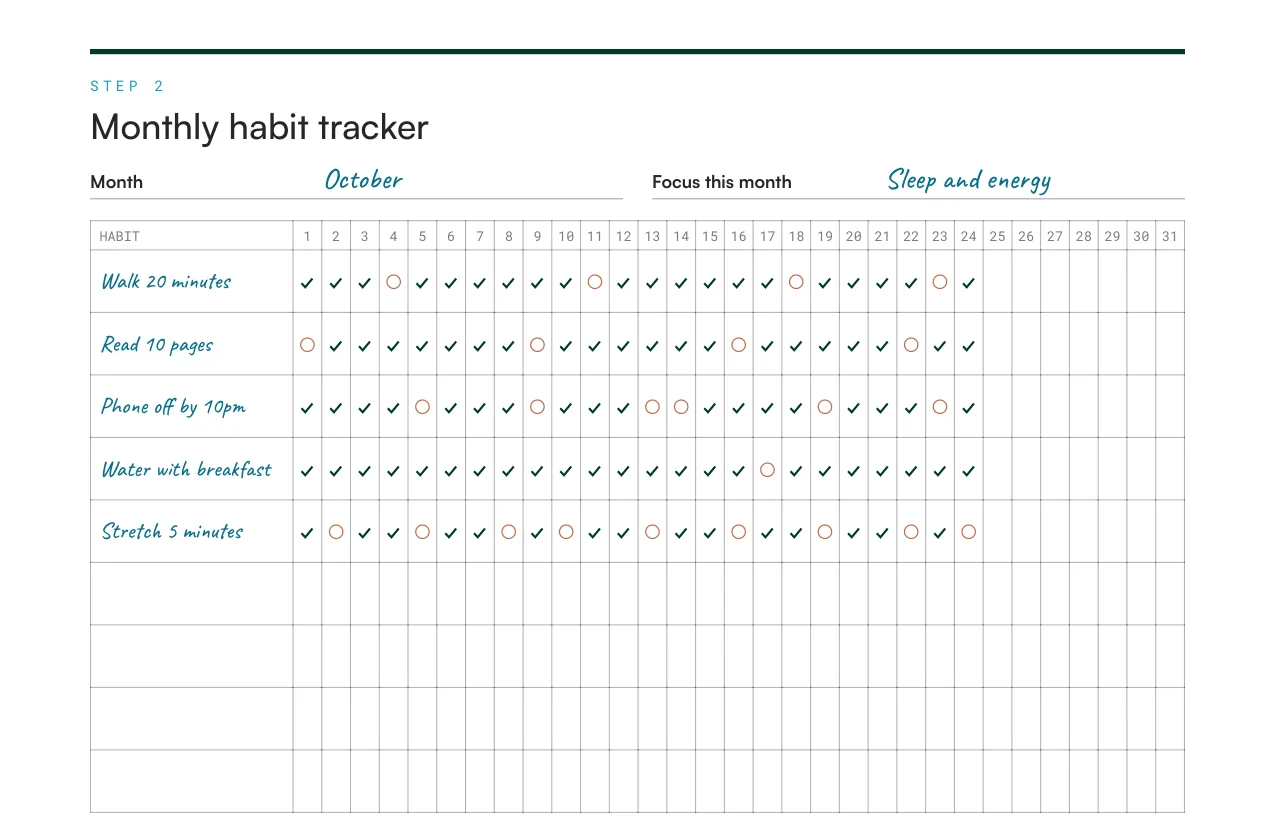
We use a simple marking system: a check for done, an open circle for missed, and blank for days that have not happened yet. Keeping missed days visible matters. A grid of only checks and blanks hides the difference between "missed" and "not yet," and that difference is where the useful information is.
At the end of the month, read the grid down the columns as well as across the rows. If every habit drops on Saturdays, you do not have five discipline problems. You have one scheduling problem, and it has a single fix.
Page 3: the weekly habit tracker
The weekly page gives each habit its own row with a "done means" column beside it and a weekly total at the end. Below the grid are three short prompts: what made it easy, what got in the way, and what you will do next week.
Those three lines are the part most people skip, and they are the most useful. A week of checks tells you what happened. The prompts tell you why, which is what lets you change something next week instead of hoping it goes better.
Page 4: the monthly review
Ten minutes on the last day of the month. List each habit, count the days, write one line about what you learned, and make a decision: keep, adjust, or drop.
"Drop" is a legitimate answer. So is "drop tracking," which is different. Once a habit happens without the tracker reminding you, retire it from the sheet and free the row for the next one. A tracker is scaffolding. The point is to need it less over time, not to fill it forever.
The four rules that make a habit tracker work
A habit tracker printable is only as useful as the rules you follow with it. These four matter more than the design.
1. Track three habits, not ten
A full grid looks ambitious on day one and discouraging by day nine. Start with the smallest set you could keep during your worst week. Add one more only once the first three feel easy. In our filled-in example, the person tracking five habits noticed at the review that the fifth one was the casualty of doing too much at once, which is the most common pattern we see.
2. Never miss twice
One missed day is noise. Two in a row is the start of a new pattern. When you see a single open circle, the only job tomorrow is to fill the next box, even with the tiny version. This one rule does more to keep a tracker alive than any amount of motivation.
3. Keep it where you will see it
A tracker in a drawer tracks nothing. Tape it inside a cupboard door, next to the kettle, or on the fridge. The act of seeing it is part of the cue.
4. Expect it to take longer than 21 days
The "21 days to form a habit" line is popular but not well supported. The study most often cited on this, by Phillippa Lally and colleagues at University College London, followed volunteers building a new daily habit and found the time to reach automaticity varied widely from person to person and habit to habit, with a median of around 66 days. Simple habits got there faster than harder ones. The practical takeaway: plan to track for at least two or three months, and do not read a hard week three as failure.
How to fill in the habit tracker: a worked example
The filled-in example follows one person through October. Their focus for the month was sleep and energy, and they chose five habits: a 20-minute walk, reading 10 pages, phone off by 10pm, a glass of water with breakfast, and five minutes of stretching.
A few things worth copying from how they used it:
- Every habit had a cue. The walk came after the first coffee. Reading came after getting into bed. The phone went into a kitchen drawer when the dishwasher went on.
- The one double miss had a reason and a fix. The phone habit broke on consecutive days during a work trip. Rather than trying harder, they packed an old alarm clock so the phone could stay out of the bedroom. The habit recovered the next day.
- The review made real decisions. Water with breakfast had become automatic, so they stopped tracking it. Stretching had slipped the most, and they recognised it as one habit too many rather than a personal failing. Next month's plan: add nothing new and lock in the phone habit.
That last point is the most important. The temptation after a good month is to add three new habits. The better move is usually to consolidate.
Habit tracker ideas to get you started
If you are staring at an empty grid, here are habits that work well on a tracker because they are daily, specific, and easy to define as done. Pick two or three, not all of them.
- Energy and health: walk 20 minutes, water with breakfast, a vegetable at lunch, lights out by a set time, no caffeine after 2pm.
- Focus and work: first hour without email, plan tomorrow before logging off, one deep work block.
- Mind: read 10 pages, five minutes of journaling, two minutes of quiet breathing before bed.
- Home and money: ten-minute tidy, log spending, no online shopping after 9pm.
- Relationships: message one friend, dinner without phones, a real question for your partner.
If you want help picking habits that serve a bigger goal, our guide on how to build good habits covers choosing and sequencing them.
What we left out, and why
- Colour-coded or decorated trackers. They look great on Pinterest and they use a lot of ink. We kept this one clean so it prints well on a home printer in black and white.
- Mood and sleep scoring. Useful, but they are measurements, not habits. Mixing them into the same grid makes it harder to read. Track them separately if you want them.
- Rewards and points systems. Some people love gamifying it. Many find the extra layer turns into one more thing to maintain. The check mark itself is enough of a reward for most people.
- A 365-day year-at-a-glance grid. Too long a horizon for building new habits. A monthly review with a real decision is more useful than a year of tiny boxes.
Where to go next
A habit tracker works best when the habits serve a goal you care about. If you do not have one written down yet, start with our goal setting worksheet, then come back and choose the two or three daily habits that move it forward.
If you want a full structure around it, the free 12-Week Goal System walks through setting a goal, breaking it into weekly actions, and tracking the behaviour that drives it. The habit tracker slots straight into that lesson.
Frequently Asked Questions
Is this habit tracker printable really free?
Yes. The PDF is free to download and print for personal use, with no email sign-up. You can print as many copies as you like.
How many habits should I track at once?
Start with three. It is enough to feel progress and few enough to keep up during a bad week. Add another only once the first three feel easy, and retire habits from the sheet once they happen without the tracker.
Should I use a monthly or weekly habit tracker?
Use the weekly tracker when you are starting new habits or restarting after a break, because each week is a fresh page. Use the monthly tracker once habits are settled and you want to see streaks and patterns across the month.
What should I do when I miss a day?
Mark it honestly as missed, then make sure you do not miss the next day, even if that means doing the tiny version. One miss is normal. Two in a row is where habits start to slip away.
How long should I use a habit tracker?
Plan on at least two to three months for each new habit. Research on habit formation suggests it often takes longer than the popular 21-day figure, and it varies a lot by person and habit. Stop tracking a habit once it happens reliably without the reminder.