


This is a free printable vision board template you can download, print, and fill in tonight. It is a seven-page PDF with vision prompts for eight life areas, a nine-panel vision board, a simpler four-panel board, a vision to action planner, and a quarterly check-in page. There is also a completed example so you can see what a finished board looks like before you start cutting.
Download the free vision board template (PDF) | See the filled-in example (PDF)
No email required. It prints cleanly in black and white on a home printer. Below we walk through each page, explain which layout to use, and cover the one step most vision boards skip: turning pictures into goals you actually work on.
What is in the free vision board template
Most vision board templates are a blank grid. That is fine for a collage, but a collage on its own rarely changes anything. We built this printable around a simple idea: a vision board should be the first page of a plan, not a poster. So it has five parts, each with one job.
- Vision prompts (page 3). A vision board worksheet for eight life areas: health, energy and sleep, food, work, learning, home, people, and adventure. For each one you write what you want a year from now, how you want to feel, and the picture that would remind you.
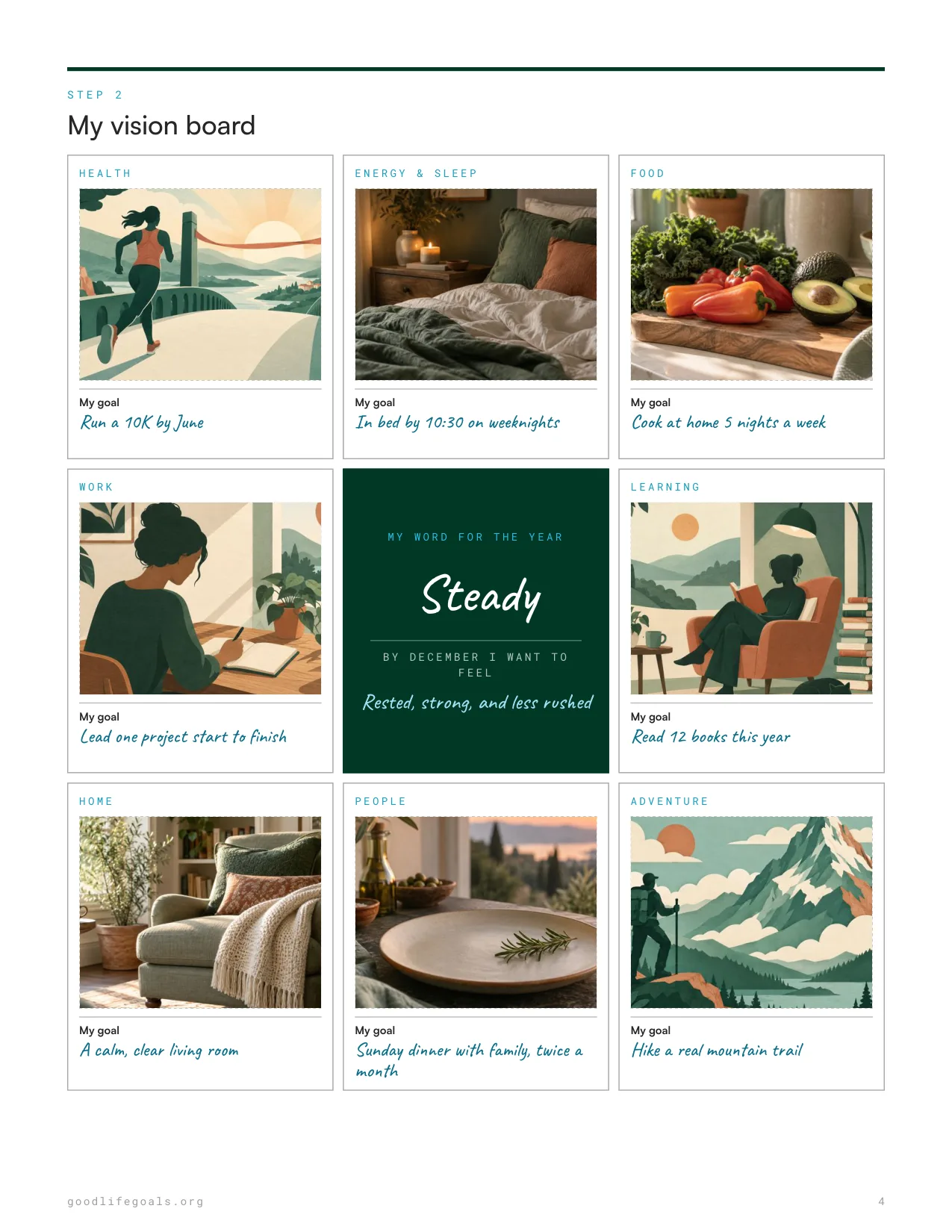
- Nine-panel vision board (page 4). Eight picture panels around a centre square for your word of the year. Each panel has a "my goal" line underneath.
- Four-panel vision board (page 5). Bigger panels, fewer areas. For a year where you want to focus instead of spreading yourself thin.
- Vision to action planner (page 6). Pick three pictures. Each gets a specific goal with a date, a first step for this week, and a weekly habit.
- Quarterly check-in (page 7). Every three months: do you still want it, what moved, and what to keep, change, or swap.
Print the whole set once. If you plan to glue photos onto the board pages, print pages 4 and 5 on card or heavier paper so they do not curl.
Nine-panel vs four-panel: which vision board layout to use
Both boards do the same job. The difference is how many things you are asking yourself to care about this year.
| Layout | Best for | Strength | Watch out for |
|---|---|---|---|
| Nine-panel board | A whole-life reset, New Year, or a big birthday | Covers every area, so nothing important gets forgotten | Easy to fill with things you like rather than things you will work on |
| Four-panel board | A focused year, or a busy season like a new job or a new baby | Bigger pictures, clearer priorities, less guilt about neglected panels | You have to choose, and choosing is uncomfortable |
| Planner page only | People who find collages awkward but still want a vision | Straight to goals and first steps | Less of the daily visual reminder that makes a board useful |
If you are unsure, do the vision prompts first and count how many areas you actually wrote something meaningful for. Five or more, use the nine-panel board. Four or fewer, use the four-panel board and relabel the panels to suit you.
Choose your approach by the problem you have
- "I made a vision board last year and forgot about it by February." The board was probably decoration, not direction. This time, fill in the goal line under every picture and complete the vision to action planner before you hang it up.
- "I do not know what I want." Skip the pictures for now. Spend 20 minutes on the vision prompts page, and leave blank any area that does not pull at you. Our list of vision board ideas has prompts for each life area if you get stuck.
- "I want everything at once." Use the four-panel board. A shorter list you act on beats a long list you admire.
- "Collages feel cringey to me." Use single words, simple sketches, or one photo per panel. A vision board does not need magazine clippings. It needs a clear picture of what you are working towards.
- "I want to see what a good one looks like." Open the filled-in example, then browse our vision board examples for different styles.
Page 3: the vision prompts worksheet
This is the vision board worksheet, and it is the page that decides whether the rest works. Each of the eight areas has three lines.
A year from now...
Write what you want to be true, in plain words. "Run a 10K." "Cook at home most nights." "A calm living room." Do not worry about making it measurable yet. That comes on page 6.
I want to feel
This line is easy to skip and worth doing. Feelings are usually the real reason behind a goal. "Strong, not sore." "Close, not just busy." When you choose pictures later, this is what you are looking for: an image that brings the feeling back, not just a nice photo of the thing.
Picture to find
Describe the image before you go looking for it. It stops you scrolling for an hour, and it keeps the board connected to what you wrote. "Runner on an open road." "A full dinner table."
Leave areas blank if they do not matter to you this year. A blank area is a decision, not a failure.
Page 4: the nine-panel vision board
The main board has eight panels around a centre square. Each panel has a label, space for a picture, and a "my goal" line.
The centre square is for your word of the year and one line: "By December I want to feel..." In the filled-in example, the word is "Steady" and the line is "Rested, strong, and less rushed." That centre square is what ties eight different pictures into one direction.
For the pictures themselves, anything works: magazine cut-outs, printed photos, your own snapshots, a quick sketch, or a single handwritten word. If you need materials, our guide to vision board supplies covers the basics, and none of them are expensive.
The most important rule: one picture, one goal. Write a goal on the line under every panel. If you cannot think of one, the picture is decoration. You can keep it if you love it, but you will know the difference when you look at the board.
Page 5: the four-panel vision board
Same idea, fewer areas. The default labels are health, work, people, and adventure, but relabel them freely. Money, creativity, faith, a move, a business: whatever your four most important areas are this year.
The bigger panels suit one strong image each. That makes this layout a good choice if you plan to photograph the board and use it as a phone lock screen, where small details get lost.
Page 6: the vision to action planner
This is the page that turns a vision board into a plan, and it is why we built this template instead of pointing you to a blank grid. Pick the three pictures that matter most right now. For each one, fill in four columns.
- The picture. Which panel you are working on.
- The goal, specific and dated. "Run a 10K by June 14," not "get fit." If you want help writing these, our guide to SMART goals with examples walks through it.
- First step this week. Small and concrete. Sign up for the race. Text your mum and book two dinner dates. A first step you can finish in a day beats a big first step you keep postponing.
- Weekly habit. The repeated action that moves the goal forward. Run Tuesday, Thursday, Saturday. One long walk every weekend.
Below the table are three short lines: the date you start, where the board will live, and who you will tell. Telling one specific person is a simple form of accountability, and it costs nothing.
Why only three?
Every goal competes for the same evenings and weekends. Three you actually start will beat eight you admire. The rest of the board is still there next quarter, when you can move one up.
Page 7: the quarterly check-in
Every three months, spend 15 minutes with your board and this page. For each goal: do you still want it, what moved, and will you keep it, change it, or swap it out.
Swapping is allowed. In the filled-in example, "Read 12 books" became "Not really" by the first check-in, so it was swapped for a short course. A vision board is not a contract. Keeping a picture you have stopped caring about just trains you to ignore the whole board.
Does a vision board actually work?
Honest answer: it depends on what you do with it. Research by psychologist Gabriele Oettingen and colleagues has found that simply fantasising about a positive future can reduce the energy people put into reaching it. Picturing the finish line can feel so good that the brain treats it as partly done.
What tends to help more is pairing the picture with reality: what you want, what stands in the way, and what you will do about it. Oettingen's approach to this is called mental contrasting. Research on implementation intentions, led by Peter Gollwitzer, points the same way: specific "when X happens, I will do Y" plans make follow-through more likely than intentions alone.
That is exactly what the goal lines, the planner page, and the check-in are for. The pictures keep the goal in front of you. The planner decides what you actually do on Tuesday.
How to fill in the vision board template: a worked example
The filled-in example follows one person planning their year. Their word is "Steady," and they filled all eight panels on the nine-panel board. A few things worth copying:
- Every picture has a goal under it. The runner is "Run a 10K by June." The made bed is "In bed by 10:30 on weeknights." Nothing on the board is purely decorative.
- Only three goals got a plan. Running, family dinners, and a mountain hike went onto the planner page. The other five stayed on the board as reminders.
- The first steps were tiny. Pay the race fee. Text Mum. Pick a trail and put a weekend on the calendar. Each one took minutes.
- The check-in made a real decision. The reading goal was swapped out, and the biggest surprise was that fixing sleep made the other goals easier.
For the step-by-step on building a board from scratch, including where to find images and how to arrange them, see our full guide on how to make a vision board.
What we left out, and why
- Pre-filled affirmations and quotes. Generic phrases dilute a board that is supposed to be about your life. Write your own word in the centre square instead.
- Dated calendar layouts. They go stale the moment you print them. This template works whenever you start: January, a birthday, or a random Tuesday.
- A colour-heavy design. It looks good on a screen and drains printer ink. The template stays clean so your pictures carry the colour.
- A "manifesting" section. We do not make claims about pictures attracting outcomes. The template is built on what the research supports: clear goals, a first step, and regular review.
Where to go next
A vision board shows where you are heading. To plan the route, pair it with our goal setting worksheet, which breaks one goal into milestones and weekly actions. For the weekly habits from your planner page, the free habit tracker printable gives you a monthly and weekly grid to check them off.
If you want a full structure around your top goal, the free 12-Week Goal System takes one picture from your board and turns it into a 12-week plan with weekly reviews. For a longer view, see how to make a 5-year plan.
Frequently Asked Questions
Is this vision board template really free?
Yes. The PDF is free to download and print for personal use, with no email sign-up. Print as many copies as you like.
What should I put on a vision board?
Pictures or words that represent specific things you want in the next year, across the life areas that matter to you. The key is to write a goal under each picture so the board points to action, not just to things you like.
How many goals should be on a vision board?
The board itself can hold up to eight, but only actively work on about three at once. Use the vision to action planner to choose those three, and revisit the rest at each quarterly check-in.
Can I use this vision board template digitally?
Yes. Open the PDF in any app that lets you add images and text, such as a PDF editor or a tablet note app, and drop your pictures into the panels. Many people also photograph the finished paper board and set it as their phone lock screen.
When is the best time to make a vision board?
Whenever you are ready to plan. New Year and birthdays are popular because they feel like fresh starts, but the template is undated on purpose. The quarterly check-in keeps it useful whenever you begin.