


This is a free printable wheel of life template you can download and fill in in about 20 minutes. It is a seven-page PDF: a blank wheel with eight life areas, a reflection worksheet for each area, a "now vs want" wheel with a gap table, a two-area 90-day action plan, and a tracker for re-scoring every three months. There is also a completed example so you can see what a finished wheel looks like before you start.
Download the free wheel of life template (PDF) | See the filled-in example (PDF)
No email required, and it prints cleanly in black and white. Below we explain what the wheel of life is, walk through the exercise step by step, and cover the part most wheel of life worksheets leave out: what to do with your scores once you have them.
What is the wheel of life?
The wheel of life is a simple self-assessment. You split your life into eight areas, score how satisfied you are with each one from 1 to 10, and shade a circle to match. The result is a picture of your life right now, and it is almost never round. The dents show you where your time and attention have not been going.
The idea is commonly credited to Paul J. Meyer, who founded the Success Motivation Institute in the 1960s, and it has been a staple of life coaching ever since. It is popular for one reason: it is fast. In 20 minutes you get an honest overview that would take hours of journaling to reach another way.
It is best used as a starting point for goal setting. Your wheel tells you where to set goals. The rest of this template helps you decide what those goals are and how to start.
What is in the free wheel of life template
- How to use it and scoring guide (page 2). What a 3, a 6, and a 9 actually mean, so your scores are consistent.
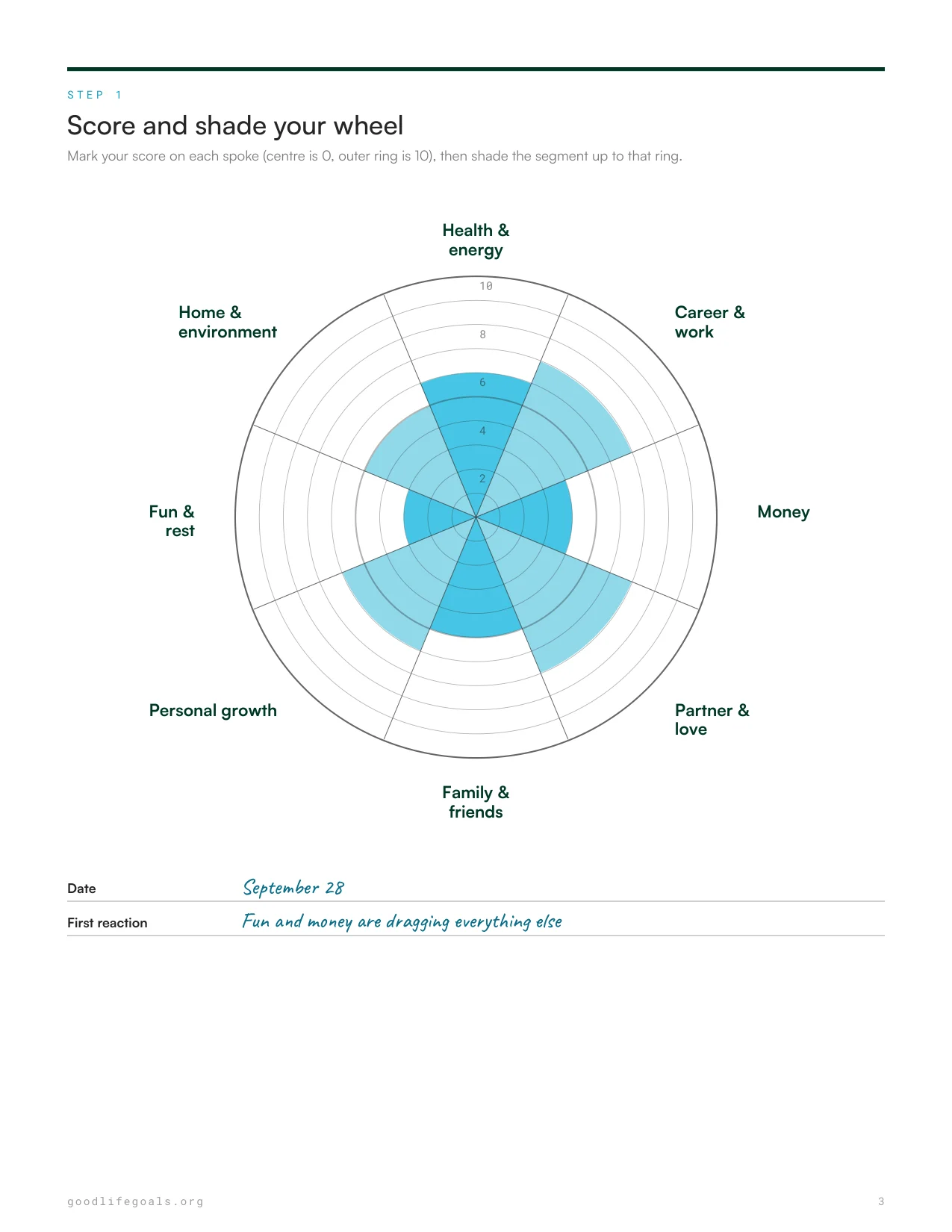
- The wheel (page 3). Eight segments and ten rings: health and energy, career and work, money, partner and love, family and friends, personal growth, fun and rest, and home and environment.
- Wheel of life worksheet (page 4). For each area: your score, what is already working, and what one point higher would look like in real life.
- Now vs want (page 5). A second wheel where you shade your current score and draw a dashed line where you want to be, plus a gap table to choose your two focus areas.
- 90-day action plan (page 6). For each focus area: a specific goal with a date, a first step for this week, a weekly habit, and an if-then plan for the obstacle most likely to stop you.
- Re-score tracker (page 7). Space to score all eight areas every three months for a year, with a running total out of 80.
Print page 3 twice. Scoring a fresh wheel in three months and laying it next to the first one is the most motivating part of the whole exercise.
How to do the wheel of life exercise, step by step
- Score each area in 30 seconds. Ask "how satisfied am I with this right now?" and write the first number that comes to mind. Overthinking pulls you towards the score you think you should give.
- Shade the wheel. The centre is 0 and the outer ring is 10. Shade each segment up to its score. Then look at the shape before you analyse anything. Your first reaction is useful, so the template has a line for it.
- Reflect on each area. On the worksheet, write what is working (so you protect it) and what one point higher would look like. One point, not ten. "Leave work on time four days a week" is useful. "Perfect work-life balance" is not.
- Mark where you want to be. Not every area needs to be a 10. Some areas are fine at a 6 for this season of your life. Draw your "want" line honestly and work out the gaps.
- Pick two focus areas and plan them. Choose two, write a specific goal and a first step for each, and put a date in your calendar to re-score in three months.
Wheel of life categories: which eight to use
There is no official list. Coaches use anything from six to twelve areas. We picked eight that cover most lives without overlapping too much. Here is what each one covers, and a question to ask yourself when scoring it.
| Area | What it covers | Question to ask |
|---|---|---|
| Health & energy | Sleep, movement, food, how your body feels day to day | Do I have the energy for the life I want? |
| Career & work | Your job, business, studies, or main daily work | Does my work use my strengths without taking over? |
| Money | Income, spending, savings, debt, and how money feels | Am I calm or anxious when I check my account? |
| Partner & love | Your romantic relationship, or dating, or being happily single | Is this area how I want it to be right now? |
| Family & friends | The people you rely on and who rely on you | Do I see the people I care about enough? |
| Personal growth | Learning, skills, reading, faith, or purpose | Am I still growing, or just maintaining? |
| Fun & rest | Hobbies, play, holidays, real downtime | When did I last do something just because I enjoy it? |
| Home & environment | Your space, your neighbourhood, the stuff around you | Does my home help me or drain me? |
If an area does not fit your life, relabel it. Common swaps are spirituality, community, creativity, or physical health and mental health as two separate areas. The exercise works as long as the eight areas cover what matters to you.
Choose your approach by the problem you have
- "I feel off, but I cannot say why." This is what the wheel is best at. Do steps 1 and 2 only, and look at the shape. The lowest segment is usually the answer you were circling.
- "Everything feels like a 5." Force a ranking. Put the eight areas in order from best to worst, then score. Flat scores usually mean you are scoring too carefully, not that your life is perfectly average.
- "I want to fix all of it at once." Two focus areas, 90 days. Our guide on prioritizing goals explains why a short list beats a long one.
- "Work is swallowing everything else." Your wheel will show a big career segment and dents around it. Pair this with our guide to a healthy work-life balance and pick one non-work area as a focus.
- "I have done this before and nothing changed." The wheel was probably the end, not the start. This time, fill in the 90-day plan on page 6 before you put the pen down.
A worked example
The filled-in example PDF shows a complete run-through. The first wheel scored health 6, career 7, money 4, partner and love 7, family and friends 5, personal growth 6, fun and rest 3, and home 5, for a total of 43 out of 80. The first reaction line says it plainly: "Fun and money are dragging everything else."
The biggest gaps were fun and rest (3, wanted 7) and money (4, wanted 7), so those became the two focus areas. Neither plan tries to close the whole gap: each aims for one point higher in 90 days. Fun and rest gets a six-week beginner pottery class, and the first step is emailing the studio that week. Money aims for one month of costs saved by December, starting with an automatic $200 transfer on payday.
The tracker shows how it went: fun beat its target, moving from 3 to 5 in the first quarter and to 6 by the second, and the total went from 43 to 52. The next two focus areas are home and health. That is the whole idea: small, visible movement, then pick the next two.
Common wheel of life mistakes
- Scoring against other people. A 10 in money is not "rich". It is "I would not change much here right now". Score your own satisfaction, not someone else's highlight reel.
- Treating a perfect circle as the goal. A round wheel of 5s is not better than a lopsided wheel of 7s and 9s. Balance matters less than whether the low areas are low on purpose.
- Setting eight goals. Every goal competes for the same evenings and weekends. Two you start beat eight you admire.
- Doing it once. One wheel is a snapshot. Four wheels a year apart show you a trend, and trends are what change behaviour.
Does the wheel of life actually work?
Honestly, there is very little formal research on the wheel of life itself. It is a reflection tool, not a validated psychological test, and your scores will shift with your mood on the day. That is fine, as long as you treat it as a conversation starter with yourself and not a diagnosis.
What the research does support is the part that comes after. Work by psychologist Peter Gollwitzer on implementation intentions found that people who plan exactly when, where, and how they will act, including "if this happens, then I will do that" plans for obstacles, follow through more often than people who only set a goal. That is why the action plan page has a first step, a weekly habit, and an if-then line for each focus area. The wheel points you in a direction. The plan is what gets you moving.
What we left out, and why
- Twelve or more categories. More segments means more scoring and less clarity. Eight is enough to be complete and few enough to finish in one sitting.
- A "perfect life" section. Writing out a flawless 10 in every area feels good and changes nothing. We ask for one point higher instead.
- Automatic totals and averages. The total out of 80 is useful for tracking over time, but the shape matters more than the number. We kept the maths to one line.
- Colour-heavy pages. The wheel prints in black and white so you can colour it in yourself. Shading it by hand is part of what makes the result stick.
Where to go next
Your wheel shows where to focus. To turn a focus area into a detailed plan, use our goal setting worksheet, and check your goal against our guide to writing SMART goals. For the weekly habits from your action plan, the free habit tracker printable gives you a grid to check them off.
If you want a visual reminder of where you are heading, our free vision board template uses the same kind of life areas, so your wheel scores make a good starting point for picking pictures. For a structured 90-day push on your top focus area, try the free 12-Week Goal System, or zoom out with a full personal development plan.
Frequently Asked Questions
Is this wheel of life template really free?
Yes. The PDF is free to download and print for personal use, with no email sign-up. Print as many copies as you like, including one for each quarterly re-score.
What are the 8 areas of the wheel of life?
In this template they are health and energy, career and work, money, partner and love, family and friends, personal growth, fun and rest, and home and environment. There is no official list, so relabel any area that does not fit your life.
How often should I do the wheel of life?
Every three months works well. That is long enough for a 90-day plan to show results and short enough to adjust before a whole year goes by. The tracker page has room for a year of quarterly scores.
What should I do with my wheel of life scores?
Pick two areas to focus on for the next 90 days, usually the biggest gaps or the areas that would lift the others. For each one, decide what one point higher looks like, set a dated goal, and take a first step this week.
Can I use the wheel of life for work or coaching clients?
Yes. The template works for coaching sessions, team check-ins, or journaling. For work-only use, relabel the eight areas to things like skills, relationships, workload, and growth, and keep the same scoring and action steps.